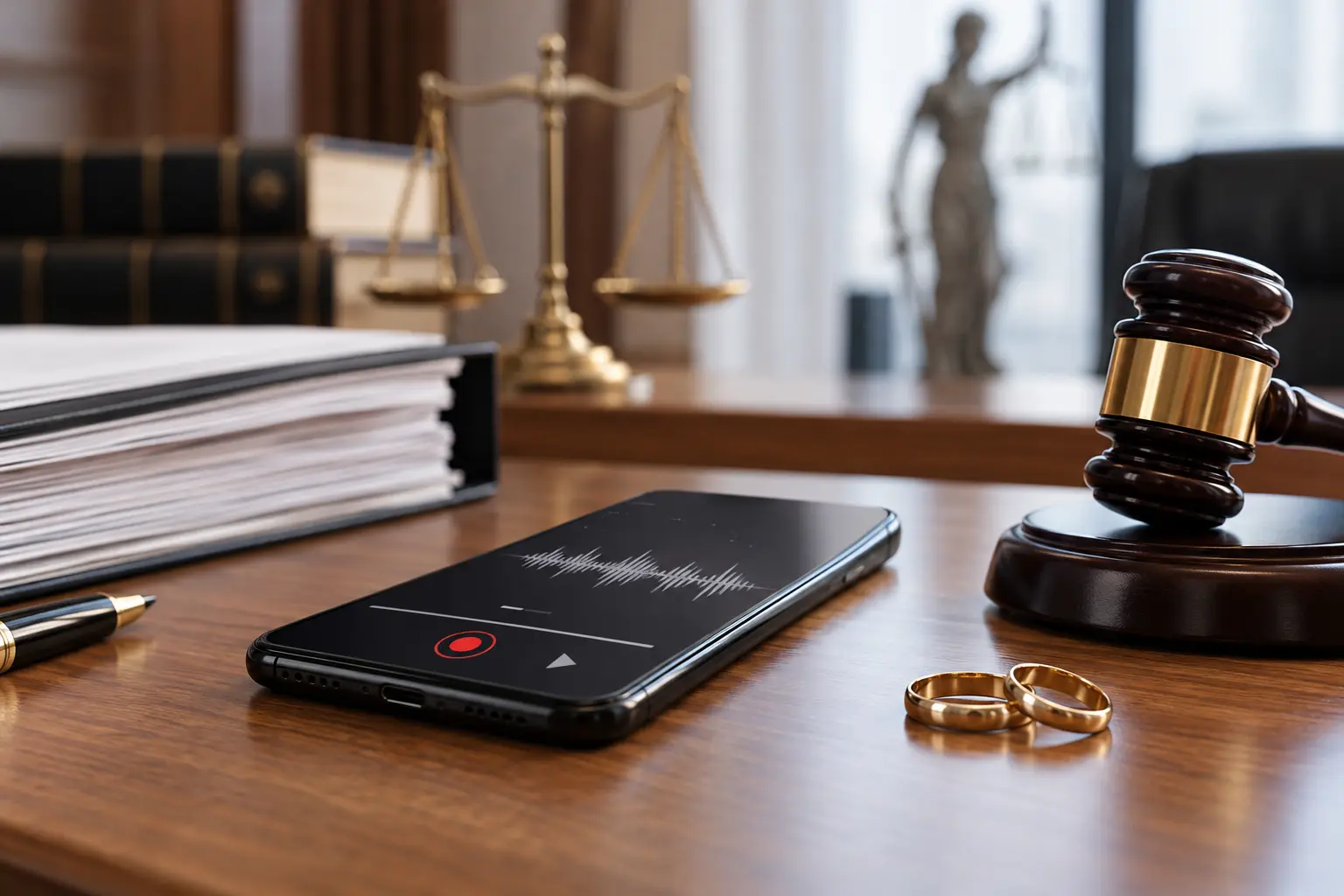
Can audio recordings be used as evidence in divorce cases in Ortaca? Under Turkish law, the admissibility of audio recordings depends on how they were obtained and the circumstances in which they were made. While some recordings may be considered by the court, evidence obtained unlawfully cannot be used in legal proceedings.
Can Audio Recordings Be Used as Evidence in Divorce Cases in Ortaca?
Audio recordings may be submitted as evidence in divorce proceedings. However, the fact that a recording contains a conversation or an incident relevant to the dispute does not automatically make it admissible. The court must assess whether the recording was obtained lawfully and whether it is relevant to the issues in the case.
In particular, recordings made secretly without the other person's knowledge may raise serious legal issues. Their admissibility depends on the method of recording, the circumstances of the incident and the applicable legal rules.
Legal Basis for Audio Recordings: Article 189(2) of the Turkish Code of Civil Procedure
Article 189(2) of the Turkish Code of Civil Procedure provides that evidence obtained unlawfully cannot be taken into consideration by the court. This rule also applies to divorce proceedings.
Therefore, when assessing an audio recording, the court may consider how it was made, whether the recording involved an interference with private life or the confidentiality of communications, and whether the evidence was obtained in accordance with the law.
Are Secret Audio Recordings Made Without a Spouse's Knowledge Lawful?
Secretly recording a spouse's conversations does not automatically make the recording admissible in divorce proceedings. Recordings made through planned surveillance, continuous monitoring or devices secretly placed in a home or vehicle may be regarded as unlawfully obtained evidence.
The legal assessment depends on the specific circumstances. The purpose of the recording, the way it was obtained and the nature of the conversation are all relevant considerations. A recording should not be assumed to be lawful merely because it is intended to support a divorce claim.
Audio Recordings Made During Unexpected Incidents
A different assessment may arise where a recording is made during a sudden and unexpected incident. For example, a person may record an event as it unfolds because there is no realistic opportunity to obtain evidence through another method.
However, this does not mean that every recording made during an unexpected incident is automatically lawful. The court must examine the particular circumstances, including whether the recording was necessary and whether it involved an unlawful interference with another person's rights.
Court of Cassation Decisions on Audio Recordings in Divorce Cases
The Court of Cassation has addressed the use of secretly obtained recordings in divorce proceedings. In its decisions, the Court has examined the manner in which recordings were obtained and whether they constituted unlawfully obtained evidence.
For example, the Court has considered recordings made through devices secretly placed in a shared home or vehicle, as well as recordings of a spouse's conversations made without their knowledge. Such recordings may be excluded from consideration where they are found to have been obtained unlawfully.
These decisions demonstrate that the admissibility of an audio recording must be assessed individually. The existence of a recording alone does not establish that it can lawfully be used as evidence.
How Should an Audio Recording Be Submitted to the Court?
If an audio recording is to be submitted in a divorce case, its original file should be preserved. The recording should not be edited, shortened or otherwise altered. Its source, date and the circumstances in which it was made may also be relevant to the court's assessment.
Depending on the circumstances, the recording may be submitted using a USB drive or another suitable digital medium. The court may request a technical examination to assess the recording's authenticity, integrity or content.
Submitting a recording does not guarantee that it will be accepted as evidence. The court must first consider whether it was obtained lawfully and whether it is relevant to the dispute.
Criminal and Legal Consequences of Secretly Recording Conversations
Secretly recording another person's conversations may also have consequences under Turkish criminal law. Depending on the circumstances, provisions concerning the confidentiality of communications, recording conversations between individuals and the protection of private life may become relevant.
Articles 132, 133 and 134 of the Turkish Criminal Code may apply depending on the nature of the conduct. Whether a particular recording constitutes a criminal offence requires an assessment of the specific facts and applicable legal provisions.
Audio Recordings and Other Evidence in Divorce Cases in Ortaca
Audio recordings are not the only type of evidence that may be relevant in divorce proceedings. Depending on the allegations, witness statements, messages, photographs, documents and other legally obtained evidence may also be considered by the court.
The evidential value of each item depends on its content, reliability, relevance and the circumstances in which it was obtained. For more information about the stages of contested divorce proceedings, see our article How to File a Contested Divorce Case .
Legal Support for Audio Recording Evidence in Divorce Cases in Ortaca
The use of audio recordings in divorce proceedings may involve complex questions concerning evidence law, privacy and criminal liability. Whether a recording can be submitted and relied upon depends on the circumstances in which it was obtained.
Individuals involved in divorce proceedings in Ortaca may consult a family law lawyer to evaluate the legal status of a recording, the available evidence and the appropriate steps to take in the proceedings.
Frequently Asked Questions
Can audio recordings be used as evidence in a divorce case?
Audio recordings may be submitted as evidence, but their admissibility depends on whether they were obtained lawfully and whether they are relevant to the case. Under Article 189(2) of the Turkish Code of Civil Procedure, unlawfully obtained evidence cannot be taken into consideration by the court.
Can I use an audio recording made without my spouse's knowledge in a divorce case?
Not automatically. A secretly made recording may be considered unlawfully obtained evidence depending on how and under what circumstances it was made. The court evaluates the specific facts of each case.
Is it a criminal offence to record my spouse's phone conversations?
It may constitute a criminal offence depending on the circumstances. Articles 132, 133 and 134 of the Turkish Criminal Code may be relevant to the confidentiality of communications, recording conversations and the protection of private life.
Can an audio recording made during a sudden incident be used as evidence?
It may be assessed differently from a recording made through planned surveillance. However, it is not automatically admissible. The court examines the circumstances of the incident and the manner in which the recording was obtained.
Is it lawful to secretly place an audio recording device in a shared home?
Secretly placing a recording device in a shared home may constitute an unlawful interference with privacy and may lead to criminal liability. A recording obtained in this way may also be excluded as evidence in divorce proceedings.
Can an audio recording be submitted to the court on a USB drive?
Depending on the court's requirements, a digital recording may be submitted using a USB drive or another suitable medium. The original file should be preserved without editing or alteration.
Can an expert examine an audio recording in a divorce case?
Yes. Depending on the dispute, the court may request an expert examination to assess the recording's authenticity, integrity or content.
Is it mandatory to hire a lawyer to use an audio recording in a divorce case?
Legal representation is not mandatory in divorce proceedings. However, legal assistance may be useful when assessing whether a recording was obtained lawfully and determining how it should be submitted to the court.
Need Legal Assistance?
For information about audio recordings, unlawfully obtained evidence and other legal issues in divorce proceedings, you may contact Esra Kırşavoğlu Law Office.
Contact Us